
Federal BOP Release Paths
The Federal Bureau of Prisons manages people serving federal prison sentences. Its system is separate from Rappahannock Regional Jail, the King George courts, and the Virginia Department of Corrections. A King George arrest does not create a BOP record unless a federal case and federal commitment follow. The U.S. Marshals Service can hold a federal pretrial defendant in a local, state, private, or federal setting before a BOP sentence begins. The actual custodian at the time controls the physical custody record.
A BOP exit can reflect completion of the federal prison term, transfer, delivery to another authority, or another BOP-specific status. A former-prisoner locator entry with “Released” and a past date is useful evidence that BOP custody ended on the date shown. It does not establish the end of federal supervised release, dismiss another jurisdiction's warrant, or exclude later state, local, or ICE custody. State the result as “released from BOP custody” rather than simply “free.”
| BOP display | Safe meaning | What to check next |
|---|---|---|
| Released plus past date | BOP custody ended on the displayed date | Federal docket and any receiving authority |
| Future release date | Projected BOP date that may change | BOP status closer to the date |
| In Transit | Movement within federal custody processing | Wait for an assigned location |
| Unknown | Confinement term not determined | Federal court and BOP record |
Search Federal BOP Release Records
The BOP Inmate Locator searches by federal register number or by name with demographic narrowing. A register number is the best starting point because it identifies the federal record more precisely than a common name. A name search should be checked against age, race, sex, and other displayed details. BOP records generally cover federal inmates from 1982 forward. Older federal prison records may require the National Archives rather than the web locator.
The search is a federal-prison check. It does not search RRJ bookings, VADOC prisons, District 21 probation or parole, ICE detention, or every U.S. Marshals pretrial placement. Keep a log of the exact name or number used, the date of the check, the displayed status, and the source link. That small record helps resolve later changes and prevents a result from one system from being misquoted as a universal custody statement.
- Use the BOP register number when known, or enter the full name and accurate demographic filters.
- Compare the result to known lawful identifiers before selecting the person.
- Transcribe the BOP status and release date exactly, including future, unknown, or transit wording.
- Check the federal court docket and any named receiving authority before describing community release.
The official BOP locator screen shows the federal search route and the kind of BOP-specific released status a former-prisoner record may provide.
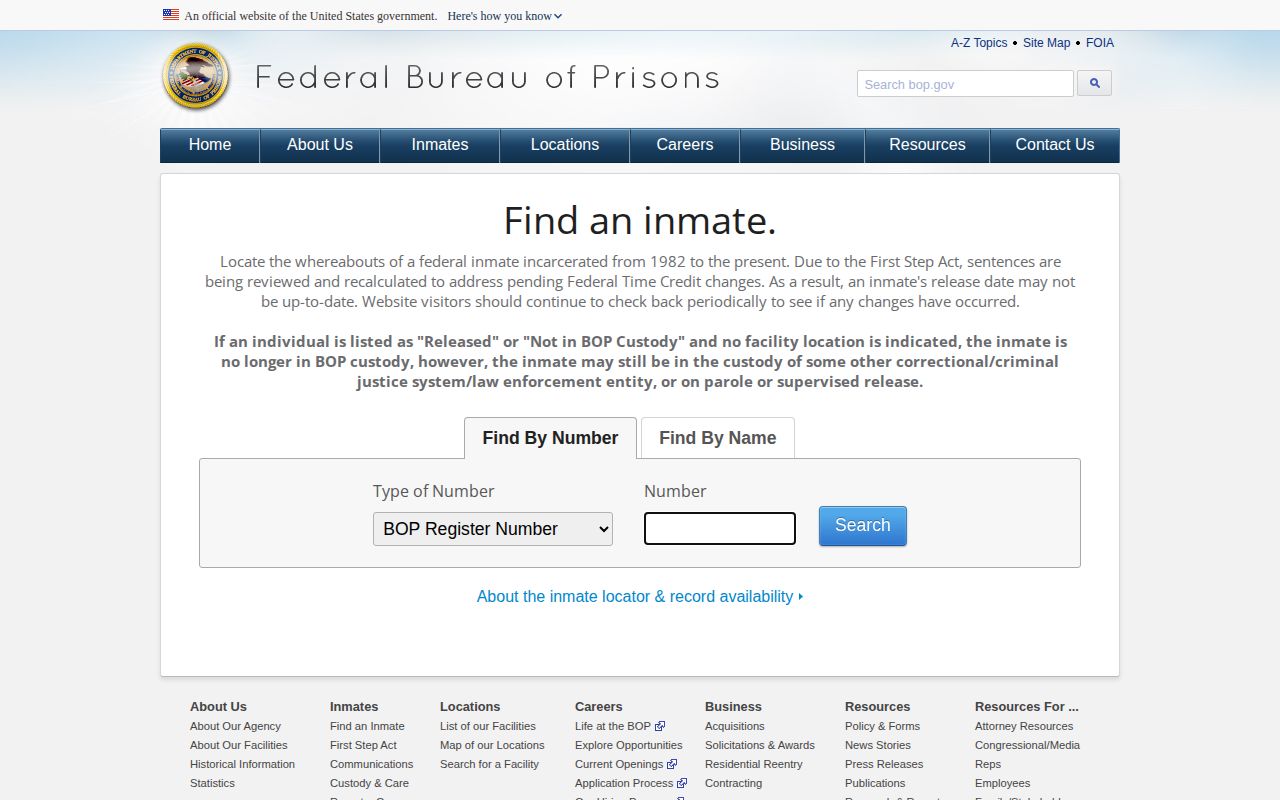
The displayed date must remain tied to BOP custody and should not be broadened into a claim about state, local, or immigration status.
Federal BOP Release Record Contact
The locator is the first public contact route for a former federal prisoner. If the result is old, unclear, or absent, use the facility named in the last known BOP record and the federal court case to identify the correct records custodian. For a pre-1982 record, follow the BOP direction to the National Archives. No BOP institution or local BOP records office was identified in King George County, so a local geographic search is unlikely to find the responsible federal facility.
Public route: BOP Inmate Locator
Coverage: federal prisoners, generally from 1982 forward
Local finding: no BOP institution identified in King George County
Older records: National Archives route
A focused inquiry uses the full legal name, federal register number if available, federal case number, last known institution, and approximate release period. Ask for an existing release or movement record rather than an explanation written from scratch. When the federal docket names a release order, detention order, or receiving authority, obtain that court record too. A judge's order supplies legal authority, while the custodian's movement or release entry establishes what happened physically.
Note: King George County and Prince George County are different Virginia localities, and federal facilities near Petersburg are not in King George.
Federal Release and USMS Custody
The U.S. Marshals Service assumes responsibility for federal prisoners from court-ordered custody through acquittal or release, or through conviction and delivery to BOP. It often uses local, state, private, or federal facilities for pretrial prisoners. A person can therefore leave RRJ under a USMS transfer while federal custody continues. RRJ's release entry should be read for the receiving authority, and the federal docket should be checked for the detention or movement basis.
USMS does not provide a general public former-prisoner locator equivalent to BOP. For the pretrial stage, the practical sources are the federal court order and actual holding facility. After delivery to BOP, use the BOP locator. If a BOP result later shows “Released,” compare the date with the federal docket and any term of supervised release. A federal supervised-release term is a court-ordered community period and is distinct from confinement in a BOP institution.
- BOP custody
- Federal prison authority administered by the Bureau of Prisons.
- USMS custody
- Federal prisoner responsibility that can include pretrial placement in another facility.
- Supervised release
- A federal court-ordered community term after imprisonment.
- Receiving authority
- The agency or facility that takes custody after a transfer.
King George Federal Release Transfers
RRJ serves King George adult local custody, but its active JailTracker is not a federal release database. If an RRJ record says the person was transferred to federal authority, use that exact agency and date as the bridge to the federal record. A roster disappearance without a release sheet does not support the same conclusion. The person might have left for VADOC, another jail, a hospital, community corrections, ICE, or a community release instead.
Start with the custodian. RRJ should document the door-out event from the regional jail. The federal court should document the federal legal authority. USMS or the actual holding facility should document the pretrial custody stage. BOP should document service of the federal sentence and the BOP exit. This chain creates a clear timeline without forcing one database to answer a question outside its scope. The King George released-inmate record search supplies the local RRJ and court steps before the federal handoff.
A King George Sheriff transport or arrest entry is also not a BOP release record. It can help identify the date and agency involved, but the federal system must verify the federal status. Use exact source labels in the final notes.
Federal BOP Release to ICE
Ending BOP custody does not rule out immigration detention. When the federal release or court record points to ICE, use the ICE Online Detainee Locator System. It can search by nine-digit A-number and country of birth or by exact biographical details and country of birth. ICE says ODLS includes current detainees and some people released from ICE custody during the prior 60 days. It excludes minors and can omit other records for safety, security, discretion, recent processing, or data reasons.
A BOP “Released” date followed by an ICE record supports a handoff between federal systems, not community release on the BOP date. Likewise, “released from ICE custody” does not alone distinguish release to the community, removal, or transfer. Ask each custodian for its own exit and receiving-authority data. If ODLS does not resolve a current question, the ICE Detention Reporting and Information Line is 888-351-4024, Monday through Friday except holidays, 8 a.m. to 8 p.m. Eastern.
Never infer immigration custody from nationality, name, or a BOP release alone. Use a specific official record or case fact that makes the ICE check relevant.
Federal BOP Release Proof
The best concise proof set has three parts: the BOP locator result or release record, the federal court disposition, and any receiving-authority record. The BOP source proves its own custody statement. The court source proves the judicial event and can show a supervised-release term. A receiving-agency entry proves that custody continued elsewhere. If those sources disagree, report the conflict instead of choosing the most convenient result.
Future BOP dates remain projections. Disciplinary decisions, court changes, sentence computations, or other custody events can affect the date before execution. A past “Released” date is stronger for the BOP event but still limited to BOP. Preserve the status text and the date on which it was observed. That practice keeps a federal record accurate even when another system changes later.