
Virginia DOC Release Paths
The Virginia Department of Corrections operates a statewide prison and community-supervision system. It is not the King George local jail. Rappahannock Regional Jail may hold a King George defendant before trial, for a short local term, or while VADOC receives a state-responsible sentence. Once VADOC takes authority, the person's location can be any assigned institution or qualifying local or regional jail in Virginia. The exact institution comes from the state locator or official record, not from the county name.
Leaving an institution may result in direct discharge, parole, mandatory release with supervision when the law applies, post-release supervision, placement in a community corrections program, or delivery to another authority. VADOC defines discharge broadly enough to include release to law enforcement for another obligation or for deportation. A signed record should state why, where, when, and to whom the person was released. That destination is essential. It prevents a transfer out of a prison from being reported as freedom from all custody.
| State record | What it can show | Limit |
|---|---|---|
| Locator institution result | Current VADOC custody or authority | Not a discharge record |
| District-office result | Current community supervision | Not final discharge |
| Projected date | Current administrative estimate | May change before release |
| Signed release document | Actual discharge event, type, and destination | May require a records request |
Search Virginia DOC Release Status
The VADOC Inmate and Supervisee Locator covers people in state institutions, probationers and parolees supervised by district offices, people in institutional hospitals, CCAP participants, and people in local or regional jails under VADOC authority. That scope is valuable after someone disappears from RRJ. An institutional or VADOC-authority local-jail result points to continued state custody. A probation or parole district result supports community supervision after physical release. CCAP is a correctional placement, not unrestricted discharge.
VADOC says locator data are updated daily, but it warns that public information may be inaccurate or outdated. Record the date of each search. Use the seven-digit DOC ID when known. It is less likely to confuse people with similar names. A name search requires the first three letters of the first name and the full last name, while location, race, gender, and age range can narrow the result.
- Accept the locator disclaimer and select the seven-digit DOC ID route when that number is available.
- Otherwise enter the required first-name letters and full last name, then add only accurate optional filters.
- Open the result and read the listed institution, local placement, CCAP program, or supervision district in its exact terms.
- Confirm an unclear or important status with the responsible institution, district office, or VADOC records channel.
Virginia DOC Discharge Records
The public locator landing page does not promise that every fully discharged person stays searchable. The reviewed live search also did not permit safe verification of a result field literally labeled projected or tentative release date. Claims about result fields should therefore stay narrow. VADOC Operating Procedure 050.6 does provide a direct date-information route. At the time of inquiry, staff may release projected parole-eligibility, mandatory-parole, or good-time release dates, as well as releasable custody or parole status and location.
For the actual event, VADOC Operating Procedure 050.3 is stronger. Before discharge, staff verify legal authority, identity, warrants, detainers, custody orders, disciplinary changes, and time computation. The agency records the reason, destination, time, and receiving person or authority and uploads signed release documents to VACORIS. Ask for the Order of Release, signed release document, actual discharge date and type, and recorded recipient or destination. Preserve VADOC's own date label. A projected date is not an executed discharge.
- Discharge
- An authorized end or change of VADOC custody that may lead to community release or delivery to another authority.
- Projected date
- An estimate based on the current sentence and credit record.
- Parole
- Conditional community release for a person who is legally eligible.
- Detainer
- An outstanding claim that may block community release or cause transfer.
The VADOC FOIA page shows the official route for an inmate or supervision record request.
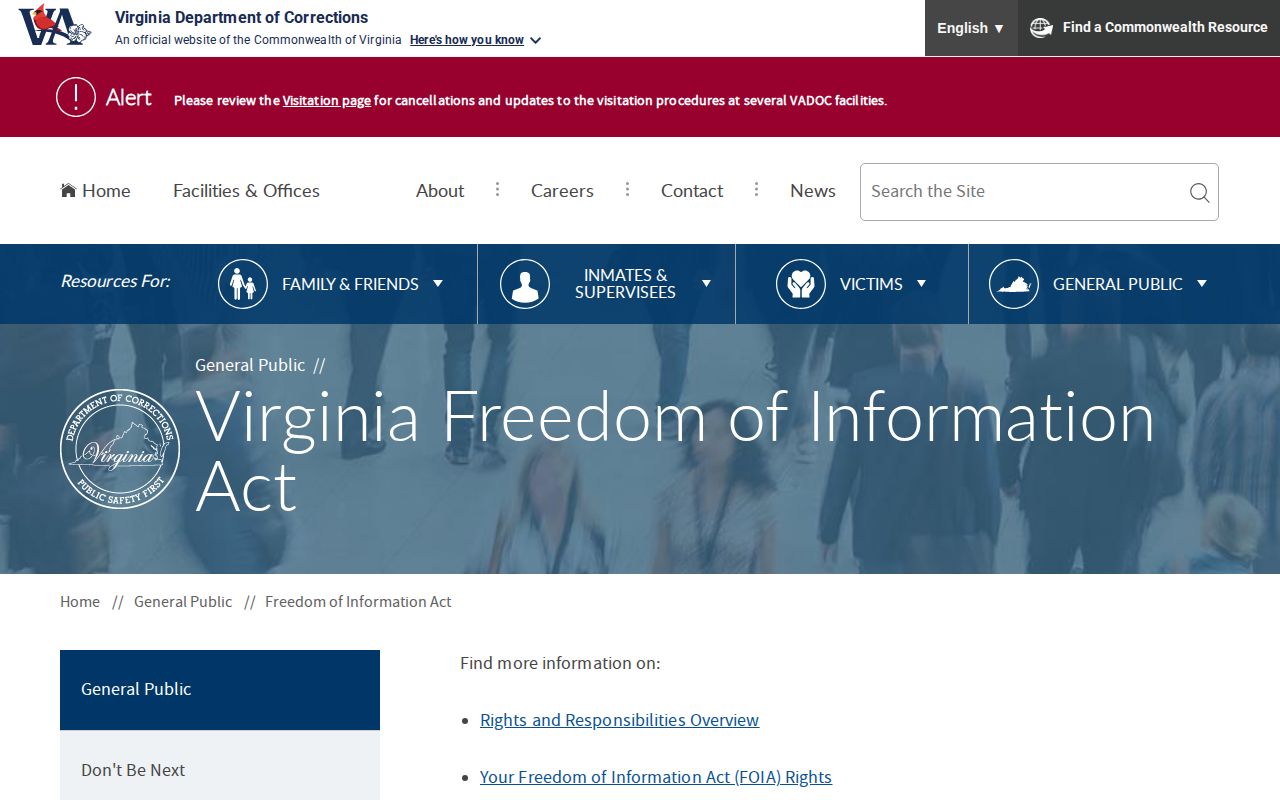
The request path is the right fallback when a former state prisoner no longer appears in active public locator scope.
Virginia DOC Release Record Contact
VADOC accepts requests by mail, fax, email, in person, and phone, though it prefers written requests. Direct inmate information to the unit manager, warden or superintendent, or probation and parole district chief that maintains the record. Give the requester's legal name and address, identify the former prisoner precisely, and describe the existing release documents sought. A person seeking their own inactive inmate, CCAP, probationer, or parolee file can review notarized Form 050_F17 under Operating Procedure 050.6. A third party should not assume access to the entire inactive file.
Anne-Cabrié Forsythe
P.O. Box 26963, Richmond, VA 23261
Phone: 804-963-2953
Email: FOIA@vadoc.virginia.gov
Central Office: 804-674-3000
VADOC describes a five-working-day response period and a possible seven additional working days. It may charge actual reasonable search, retrieval, copying, and postage costs, provide an estimate, and require a deposit when an estimate exceeds $200. Operating Procedure 050.6 lists $0.10 per page, actual postage or shipping, and actual reasonable research labor for its copy process. Virginia law makes imprisonment and state probation or parole records discretionary in important respects, so a request may yield specified public data rather than the full file.
Note: Ask for the exact signed discharge document and destination field instead of asking VADOC to write a new account of the release.
Virginia DOC Release Supervision
Physical release from a VADOC institution may lead to supervision rather than final discharge. King George is assigned to Probation and Parole District 21 in Fredericksburg. The same VADOC locator can associate a person with that district. A district result differs from an institution result: it points to community supervision, not prison confinement. A probationer follows a court-imposed sentence in the community. A parolee has conditional release under the rules that apply to the eligible case. Post-release supervision is another court or statutory period after custody.
Virginia abolished discretionary parole for most felony offenses committed on or after January 1, 1995, subject to limited exceptions. Never infer parole eligibility from the age of a person, the sentence length alone, or a general fraction. The Virginia Parole Board decides eligible release matters, while VADOC Community Corrections supervises the person. A Board grant is not the physical release date because planning, notice, certification, detainer review, and execution still follow.
Final discharge may remove a person from the locator's active scope. When that occurs, use the inactive-record process and the King George Circuit Court order to establish the completed legal and correctional history. Keep each source in its lane: the court proves the judicial act, VADOC proves state custody and discharge, and District 21 confirms current office routing.
Virginia DOC King George Transfers
No state prison was identified within King George County. That negative finding prevents a false facility search. A state-responsible person can be received at RRJ and sent to an institution elsewhere, so the statewide locator must determine the assigned site. If RRJ no longer lists the person but VADOC lists an institution or VADOC-authority local jail, the evidence supports a transfer into the state system, not a community release.
Federal and immigration custody remain separate. A VADOC discharge document may show delivery to another law-enforcement authority or for deportation. Follow that destination with BOP, ICE, the court, or the actual recipient. Likewise, a court sentence and a jail credit calculation do not by themselves prove the day VADOC carried out release. The signed state release record remains the key custody-exit evidence.