
King George Parole and Probation
Virginia separates the decision to release a person on discretionary parole from the work of supervising that person. The Virginia Parole Board makes eligible parole decisions. VADOC Community Corrections supervises parolees, probationers, and people serving post-release supervision. Probation usually comes from a court order and can follow suspended jail or prison time. Parole is conditional release from a sentence for a person who remains legally eligible. Post-release supervision is another court-ordered period after confinement. All three can continue after the person is no longer housed at Rappahannock Regional Jail.
The order and the current custodian answer different questions. A King George Circuit Court order can establish the length and conditions of probation. A VADOC district-office result can show that the person is now assigned to community supervision. Neither proves the exact moment RRJ completed release processing. When the goal is to confirm both events, read the court record and the VADOC result, then seek the jail release sheet for the door-out event.
| Supervision type | Source | What it means |
|---|---|---|
| Parole | Virginia Parole Board decision | Conditional community release for a legally eligible sentence. |
| Probation | Sentencing court order | Court supervision, often tied to suspended time and stated conditions. |
| Post-release supervision | Court and VADOC records | A defined supervision term that follows incarceration. |
| Final discharge | VADOC or court record | The applicable correctional supervision term has ended. |
- Discharge
- The formal end of the applicable sentence or supervision status.
- Absconder
- A person officially alleged to have stopped reporting or left supervision, a status that must be confirmed by the agency or court.
- Detainer
- A request or order from another authority that can affect release or transfer.
- CCAP
- Virginia's Community Corrections Alternative Program, which is not the same as unrestricted community release.
Verify King George Supervision Records
The VADOC Inmate and Supervisee Locator covers people in state institutions, probationers and parolees assigned to field offices, CCAP participants, institutional-hospital placements, and some people held in local jails under VADOC authority. That broad scope is useful, but the location label must be read. A District 21 result points to community supervision. An institution, CCAP, or local-jail placement does not show ordinary community freedom. VADOC says the locator updates daily and warns that information may still be incomplete or stale.
A seven-digit DOC ID is the best search key when known. The name option calls for the first three letters of the first name and the full last name, with optional location, race, gender, and age filters. Record the date of the search. Compare lawful identifiers before deciding that a result belongs to the right person.
- Search the VADOC locator by DOC ID, or use the required name format and careful optional filters.
- Read the location and status as written. Separate District 21 supervision from an institution, CCAP, or jail placement.
- Search the King George court case and read the sentencing or violation order for the term and legal conditions.
- Contact District 21 when the locator is unclear or appears stale. Ask about office routing, not confidential case notes.
- Request the RRJ release record when the exact physical release event, authority, or destination must also be established.
Important: No locator match does not prove discharge, and it never establishes absconder status by itself.
The full custody-exit sequence is covered through the King George County released-inmate search and records path.
King George District 21 Supervision
King George County is assigned to VADOC Probation and Parole District 21 in Fredericksburg. Its service area also includes Fredericksburg, Stafford County, and Spotsylvania County. The office can confirm whether a public locator result is routed to the correct district and can direct a records question. It does not owe a caller access to confidential supervision notes.
VADOC Probation and Parole District 21
5620 Southpoint Centre Boulevard, Suite 110
Fredericksburg, VA 22407
540-710-2102
The sentencing court is a second source. King George Circuit Court handles felony sentencing and probation-violation orders. General District Court handles misdemeanors and preliminary felony matters. A district-office record describes correctional supervision, while a certified court order supplies the legal term. If those sources conflict, preserve both results and ask the responsible offices to correct or explain the mismatch.
Note: A District 21 location is evidence of field supervision, not proof that every court obligation or separate custody matter has ended.
King George Monitored Release Options
RRJ operates a local layer that can look like release from a secure unit without being a final discharge. RRJ Community Corrections includes Pretrial Services, Community-Based Probation, work release, home electronic monitoring, and treatment court. Pretrial Services works with judicial detention and release decisions before trial. Community-Based Probation is a court-ordered, post-sentence option. These are distinct from VADOC parole and probation even when both involve supervision outside a standard cell.
Work release participants return to RRJ and remain confined. RRJ describes eligibility factors that include a low-risk, nonviolent assessment, less than twenty-four months to serve, and no pending court matters. Home electronic monitoring has its own criteria, including less than twelve months to serve, no further court dates or pending charges, and a suitable home plan. The program page lists a daily charge. These facts make the placement label crucial.
The successful RRJ community-corrections source capture shows the local options and contact route:

The image supports the local supervision path, but it does not identify any person's current placement or prove final release.
King George Supervision Violations
A supervision condition comes from the controlling order and agency rules. Common high-level duties can include reporting, obeying the law, and following location or treatment terms, but only the person's actual order and supervision record establish the applicable terms. A suspected breach may result in agency action, a warrant, or a court hearing. It should not be inferred from rumor, a missed public result, or a change in the VADOC locator.
No official statewide public VADOC absconder list was found in the research sweep. Verify an alleged violation or warrant through District 21 and the relevant King George court. Circuit Court publishes probation-violation sessions on the second Tuesday, though schedules can change and should be checked before travel. A violation filing proves a court matter exists. It does not prove the final ruling, and it does not reveal the exact time of any later arrest or release.
Parole Board reports have separate meanings. A grant, not-grant, revocation, certification, or deferred review is a decision event. Even a grant is not a physical release date because planning, notice, and final checks still follow. VADOC or a signed release record must confirm the custody change.
King George Parole Decision Records
Virginia ended discretionary parole for most felony offenses committed on or after January 1, 1995, subject to limited statutory exceptions in Code § 53.1-165.1. Older and specially eligible cases require individual review. A simple sentence fraction cannot establish eligibility because exclusions, life terms, commitment history, and special categories can change the result.
The Parole Board's public meetings occur on an event-based, irregular schedule. There is no dependable King George County advance list for each inmate. Completed decisions appear in monthly parole reports, which may include a DOC number, name, case type, decision date, result, reasons, jurisdiction, offenses, and sentence data. Those retrospective reports should be matched to a VADOC custody or supervision result.
The Commonwealth Calendar capture shows the official route for announced public meetings:
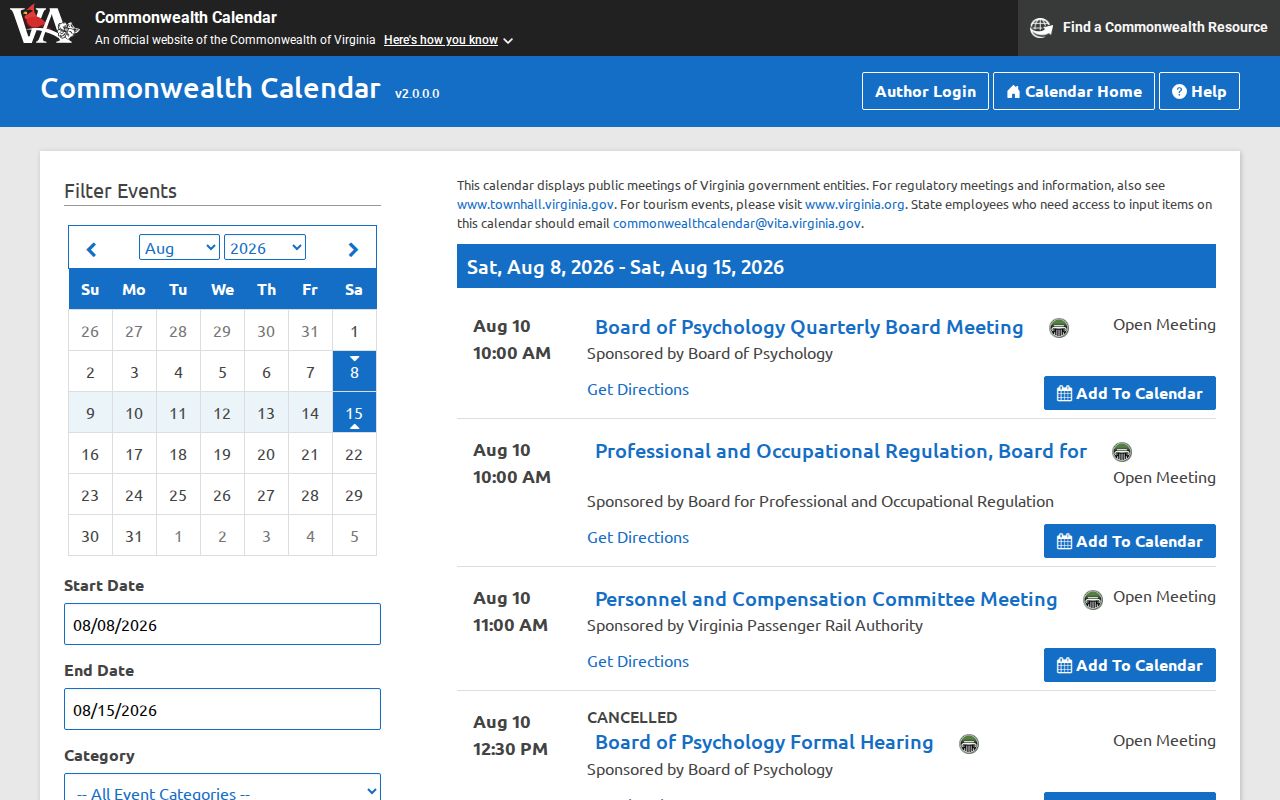
The calendar documents announced meetings, not a county-filtered custody list or a promise that a named person will appear.
King George Release Property Records
Scheduled community release includes return of personal property held by RRJ. Transfer property follows a different path. RRJ permits certain legal and religious material to travel, while other property may be held for thirty days under a signed third-party disposition. Property pickup and release-clothing exchanges are listed Monday through Saturday from 8 a.m. to noon. That rule should not be applied to every routine community discharge.
Property entries can help tie a record to a specific event, but they do not replace the release sheet. Ask RRJ for the release date and time, release type, authority, and destination as maintained. If an inactive VADOC record contains an error, Operating Procedure 050.6 supplies a written correction route through the responsible unit and central or regional records administration. Keep copies of the challenged field and the agency response.
Supervision ends only through the governing legal process. A completed probation term, parole discharge, or other final discharge should be supported by the court or VADOC record that states it. Physical release, return of property, and final correctional discharge may occur on different dates.
To document the end of King George County supervision, first read the latest court order for an end date, extension, violation, or early termination. Then check whether VADOC still places the person at District 21. If a public result remains after the stated end, ask the district to review its routing and current status. If a fully discharged person no longer appears online, request the releasable inactive-record fields through the responsible VADOC unit. Operating Procedure 050.6 provides a correction route for inaccurate inactive inmate, CCAP, probationer, and parolee information. A court's end date and the agency's formal discharge entry should be kept together because one establishes the legal term while the other records the correctional status change.
Note: Preserve each agency's exact date label because release, supervision start, and final discharge are separate record events.