
King George Projected Release Dates
A projected date is an administrative estimate based on the sentence data and credits known at the time. An actual release is a completed custody event. The difference matters in King George County because RRJ handles local jail sentences while VADOC handles longer state-responsible sentences. A projected parole-eligibility date, mandatory-parole date, good-time date, estimated date, and final discharge date can all differ. Preserve the exact field name and the date on which the agency supplied it.
Pretrial detainees usually do not have a sentence-completion date. Their release may depend on bond, recognizance, dismissal, a court order, or the outcome of a pending case. A detainer, which is a request or order from another authority, can keep custody in place after the King George matter changes. For a sentenced person, the calculation begins with the active term, offense dates, jail credit, governing credit system, and any later orders.
The jail's release sheet is the best source for RRJ's actual door-out time. VADOC's signed release documents are the stronger source for state discharge. A court order supplies legal authority but does not, by itself, prove when the custodian completed processing.
Lookup King George Release Dates
Start by deciding whether the sentence is a short local term or a state-responsible term. RRJ says its Inmate Records staff compute local sentence totals of twelve months or less. For a state sentence over twelve months, RRJ forwards jail credits and VADOC computes the date. The court clerk can supply the sentencing order, but the clerk does not replace the agency charged with time computation.
The VADOC Inmate and Supervisee Locator is useful for people under VADOC custody or supervision. Search by seven-digit DOC ID when possible. The name route requires the first three letters of the first name and the full last name, with optional location, race, gender, and age filters. The research could not verify that every live result has a field literally named “Projected Release Date,” nor does VADOC promise that every fully discharged former prisoner stays searchable.
- Identify the custodian and sentence type. Check whether the person is at RRJ, under VADOC authority, or in another system.
- For a VADOC matter, search the locator and record the exact location, status, date label, and access date.
- For an RRJ local term, ask Inmate Records for the maintained computation or release record. RRJ does not promise release dates by phone.
- Read the King George sentencing order for active time, suspended time, and whether terms run at the same time or one after another.
- Ask the computing authority for the “as of” date, sentences included, jail credits received, and any orders or detainers not yet calculated.
- After the scheduled date, confirm the actual event through the signed jail or VADOC release record.
A no-result is unresolved. It can reflect spelling, delay, a person outside VADOC scope, or final discharge from the locator's active view. The King George County released-inmate search explains how to check court, VINE, local, state, and federal systems without treating absence as proof.
King George Release Date Handoff
The local-to-state handoff is a distinctive part of King George sentence computation. RRJ calculates qualifying local totals of twelve months or less. VADOC calculates state totals over twelve months after RRJ supplies jail credits. RRJ says a Legal Update Sheet is ordinarily expected ninety to one hundred twenty days after final sentencing for a VADOC-sentenced person. It supplies the state number and an estimated release date.
That delay does not mean the sentence has no end date. It reflects record transfer, jail-credit review, and VADOC computation. A newly sentenced person may remain at RRJ while the state-responsible record is processed. Calling the court to recalculate the date will not resolve the issue because the court enters the order but does not perform the custodian's final time computation.
Ask RRJ whether credits and the final order have been forwarded. Ask VADOC whether all active sentences and credits are in the calculation. If the Legal Update Sheet and a later VADOC record differ, keep both dates and their “as of” points. The later figure may reflect a corrected credit, added order, classification change, or another event.
Note: The local or state agency that owns the calculation should explain its date; a roster disappearance cannot supply the missing computation.
King George Earned Release Credits
Virginia uses more than one credit regime. VADOC says Good Conduct Allowance, or GCA, generally covers felony offenses committed before January 1, 1995 and misdemeanor offenses committed before July 1, 2008. For active or combined parole-eligible GCA sentences over twelve months, VADOC may calculate discretionary-parole eligibility, mandatory-parole release, and good-time dates. Classification under Code §§ 53.1-198 through 53.1-202 can range from no credit to thirty days for thirty days served.
Earned Sentence Credit, or ESC, generally applies to felony offenses committed on or after January 1, 1995. Under § 53.1-202.2, one credit represents one day deducted, subject to eligibility and classification. VADOC calls offenses listed in specified parts of § 53.1-202.3 ESC-1. Those rates range from zero to 4.5 credits per thirty days served. Eligible ESC-2 offenses can range from zero to fifteen days per thirty, based on class and compliance.
The common “serve eighty-five percent” phrase is not a universal Virginia rule. At the top 4.5-for-30 rate, 30 actual days plus 4.5 credit days satisfy 34.5 sentence days, or about 86.96 percent actual confinement for that block. Eligible ESC-2 terms can earn more, while older GCA and local rules differ. The offense date, conviction, statutory category, conduct class, and sentence mix determine the rate.
The official VADOC time-computation source is shown in the successful research capture:
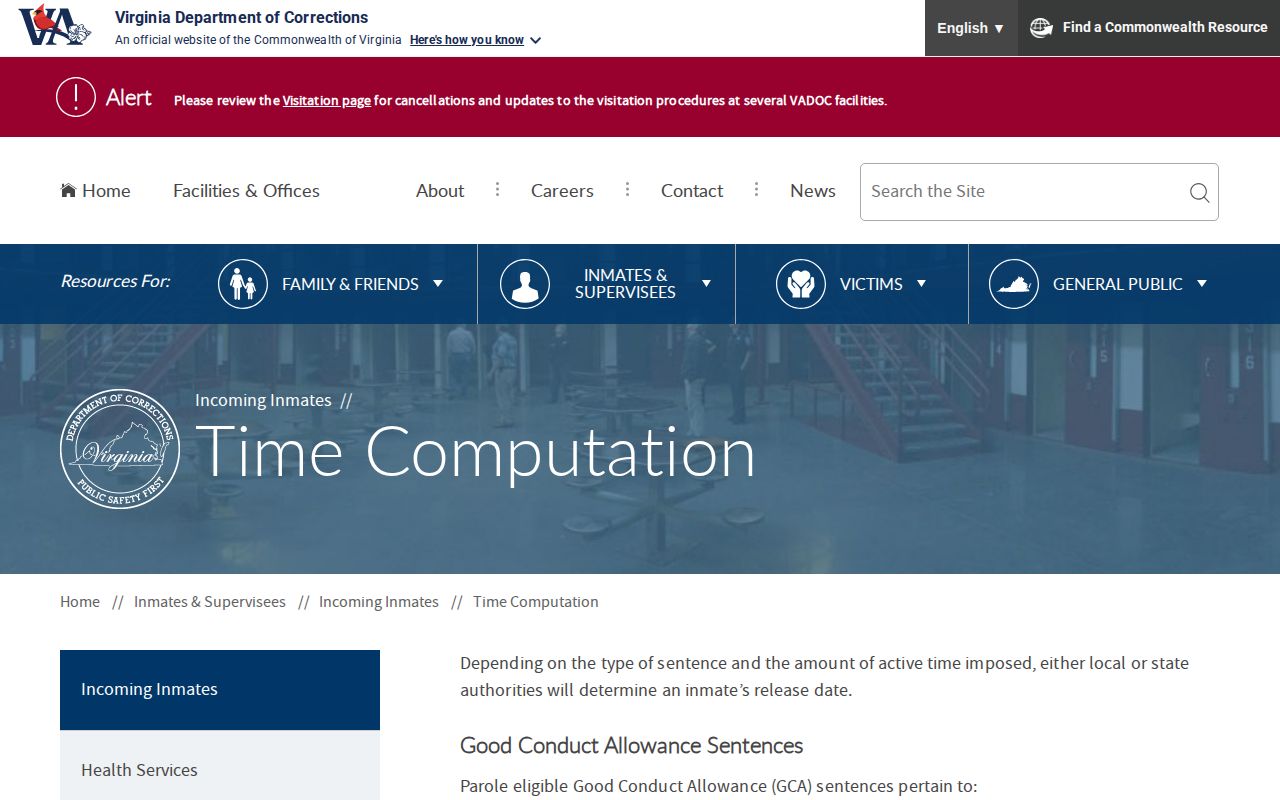
The image identifies the state rules page. It does not calculate a date for a named person, so the agency record remains essential.
King George Local Release Credits
Local jail computation follows a separate framework. Virginia Code § 53.1-116 requires the jailer to keep commitment, term, offense, and receipt records and a written policy for credit and revocation. Unless a mandatory minimum applies, a qualifying misdemeanor sentence totaling no more than twelve months can earn one day of good-conduct credit for each day served without a rule violation. Other provisions cover parole-eligible people and possible credit for qualifying work or programs.
RRJ, not VADOC, owns the calculation for the short local sentence it describes. Request the computation as maintained and ask which sentence, jail-credit period, and credit rule it includes. A local release at the end of time served is also distinct from a transfer to VADOC. Transfer ends the RRJ stay but continues custody elsewhere.
RRJ publishes an 8:00 a.m. release time for time-served inmates on the sentence-completion date. That narrow statement does not apply to bonds, new court orders, transfers, immigration events, or every other release class. VADOC separately says state discharge or parole release occurs by 11:59 p.m. on the scheduled date, weather permitting. Neither statement is a precise appointment promise beyond its own system and release type.
Why King George Release Dates Change
A projected date moves when the underlying facts change. VADOC identifies pre-reception jail credit, sentence type, total active term, class level, disciplinary offenses, and later events as calculation variables. Courts may add or correct orders. Agencies may identify another hold. Credits can be forfeited or restored. The useful question is not simply whether the date moved, but which source field changed and when the agency applied it.
| Factor | Possible effect | Source to confirm |
|---|---|---|
| Jail credit | Moves the computed term when credit is added or corrected. | RRJ credit record and VADOC calculation |
| Earned-time class | Changes the rate at which eligible credit accrues. | VADOC time-computation record |
| Discipline | May reduce, forfeit, or delay credit under the governing rules. | Custodian's maintained record |
| New court order | Can add time or change concurrent and consecutive treatment. | Certified court order and recalculation |
| Detainer or warrant | May change the destination or prevent community release. | Release custodian and issuing authority |
| Parole decision | Affects eligible cases but does not itself execute release. | Parole Board report and VADOC release record |
Mandatory release under § 53.1-159 can place a qualifying person under supervision before final discharge, subject to exceptions. That date is not the same as the day all correctional control ends.
Confirm King George Actual Release
When the scheduled day arrives, use the custody system that holds the person. For RRJ, request the release log or sheet showing actual date and time, release authority or type, and destination or receiving agency as recorded. RRJ's published phone policy does not promise historical release dates. A focused written request is the dependable path.
For state custody, VADOC Operating Procedure 050.6 permits release of specified projected parole-eligibility, mandatory-parole, and good-time dates at inquiry. The stronger proof of an executed discharge is the signed state release document. VADOC procedures record why, where, when, and to whom the person was released after checking identity, authority, outstanding warrants, detainers, and changes in calculation.
Virginia Jail VINE can report a local custody event, but it is not a permanent history. The VINE Inmate Check explains event alerts and the separate VADOC NAAVI handoff. A release alert proves that the reporting custodian supplied that event. It does not by itself establish unrestricted community release.
A useful confirmation record should preserve the person's recorded name and identifier, the computing agency, every active sentence included, the credit regime, the amount of jail credit received, and the exact label attached to each date. Add the query date and source URL or request reference. If RRJ, VADOC, and a court record appear to conflict, do not choose the most convenient date. The certified court order controls the legal sentence, while the custodian's signed release or transfer record is the strongest proof of the physical event. Ask both offices about any order or credit that had not reached the calculation. This log also helps distinguish a corrected projection from an actual discharge and prevents an old estimate from being repeated after the agency changed it.
Note: Keep projected, eligibility, mandatory-parole, good-time, and actual discharge dates in separate fields when recording the result.